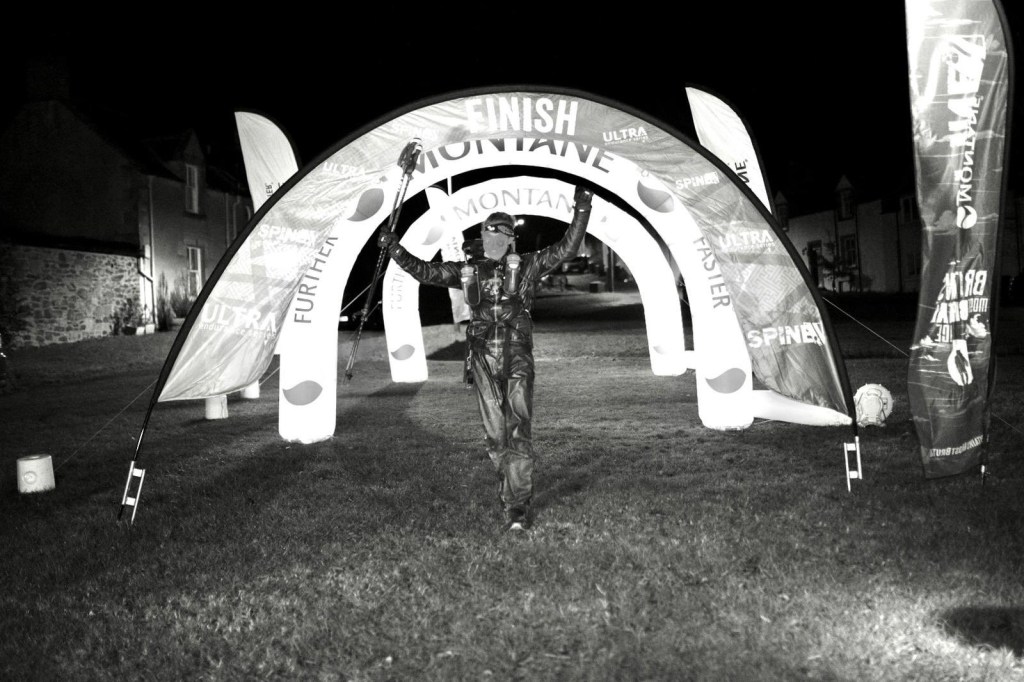
– Originally appeared in the Irish Runner print edition in 2022 –
Eoin Keith, from Cobh Co. Cork, winner and defending champion of the 2022 Montane Spine Race speaks to the Irish Runner about how he keeps his cool in some of the world’s toughest races and how he has honed his race winning, ultra-distance mind set.
Eoin Keith is a man who excels under hardship. He routinely tests his resolve as a person and an athlete in some of the most beautiful and equally rugged trails in the world. His mind set has been forged over a long and varied ultra-career, with multiple podium results and course records in epic events that frequently feature on top 10 lists for the ‘toughest’ races in the world.
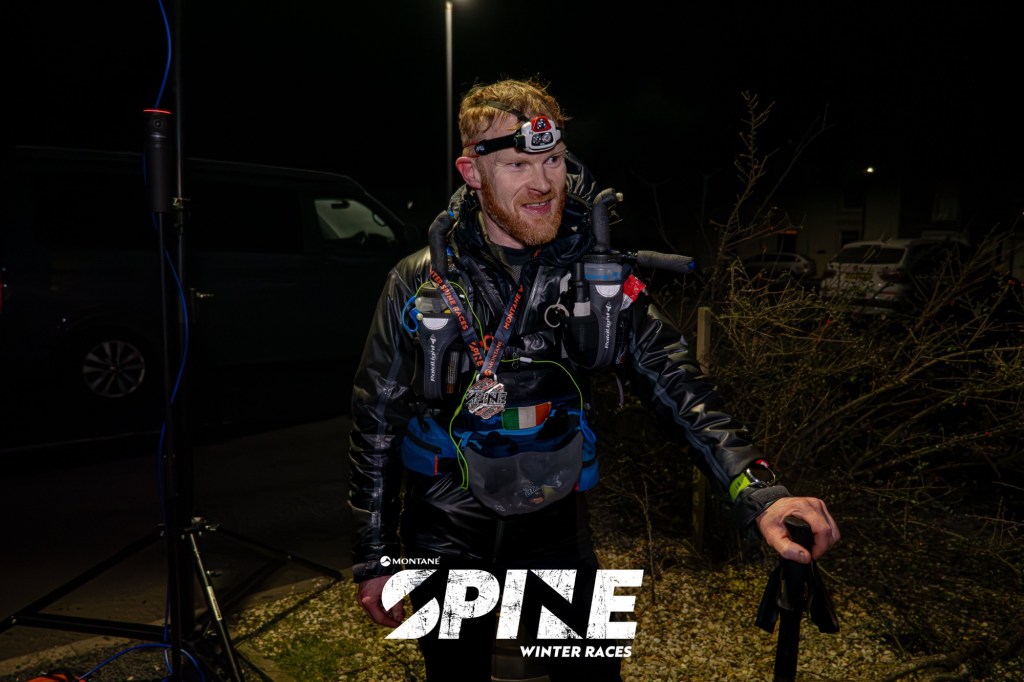
Most recently, he took first place in the 2022 Spine Race with a time of 92:40:30, a 429km route and one of the hardest ultra-distance trail races this side of the world.
Some of his other career highlights include the Summer Spine Race in 2021, making him the only back-to-back winner of the event so far, two top five finishes in his age category in the UTMB (fourth in 2019 and second in 2021) and another first-place finish in the UTMB Oman race series in 2019.
Eoin’s approach to racing is mature and thoughtful. He doesn’t put pressure on himself to win but instead enters with an open mind, focused on continuous-improvement and with the goal of using his experience and preparation to minimise the lows associated with ultra-racing, and maximise the highs.
“Learning to learn is probably one of my more useful attributes as a runner… you learn tonnes after a bad race once you’re prepared to think about it and figure out what went wrong, and what you can do to correct it.”
Racing has helped Eoin develop a more rational mind set which he uses both on and off the trail. In his early career as an adventure athlete he would take part in complex events that required a lot of planning just to get to the start line with all of his gear. They would usually require him to bring kayaks and mountain bikes – when travelling internationally he would carry next to 50kgs of gear – with running only making up a portion of the event.
“In long distance ultras and adventure races you would get thrown curveballs… and you have to learn to deal with them. Particularly in adventure racing, it is just part and parcel… it is actually one of those aspects of sport that feeds back to life in general very much, in terms of learnings that apply to all aspects of life.”
Learning to cope with the unknown while remaining composed in situations of great physical and mental stress are all apart of the game. It is why Eoin likes to deal with the facts in a race, using them to help him achieve his goals.
“I like to make rational decisions and I always say that if someone is giving me information in a race that I want to know the truth, not something varnished. Give me the accurate information so I can work with it and then calculate what I will do from there.”
Eoin looks at each event as a potential to learn and test his strategies. When evaluating an event he says the first time you run a course is a total learning experience, the second time is the real race.
“One of the best attributes you can have as a racer over any distance is the ability to learn, preferably learn from other people’s mistakes but definitely from your own.”
This approach to racing has helped Eoin on and off the trial. He has attributed his experience racing to having helped him to become a calmer and more rational person.
“I am a cerebral runner in the sense that, if I can, I prefer to out think people than out run them… It fits into the calm and rational approach and definitely not panicking or reacting badly when things go amiss, and things do go amiss.”
One challenge most runners face are injuries that creep up on us, usually just before a major race. Eoin has dealt with his fair share, some more serious than others but his process of getting back remains the same, focus on coming back stronger and don’t turn a small injury into something chronic and long lasting by not giving it the proper time to heal.
“When an injury comes, look at the long-term and forget the short-term. Make sure that you recover 100% from the injury and that you do what it takes to fully recover the injury and that you don’t come back too soon.”
Eoin had to zoom out and take the long-term view when he received a diagnosis for osteoporosis a few years ago. It has since become something he manages by taking a proactive approach to help ensure he stays ahead of it. Now he works to mitigate the inherent risk of taking a tumble during an ultra-trail race, while still competing at a high level.
“It adds to the risk but I am aware of it and it becomes something else to manage. It is now more important to me in my head that I don’t have a high-speed trip and wreck myself knowing that the potential for breaking a bone is higher.”
Despite this, Eoin trains year-round with little to no downtime or off-season. His race calendar sees him competing in multiple events, both home and away, per year leaving little time for downtime.
“If I start to feel over trained and over raced then I will take my off season and take a week or two off.”
Dealing with the pressure of racing has become second nature to him. He prides himself on his ability to stay calm and not go out too fast on the course.
“People wreck themselves at the start, it is the classic mistake with ultra races, 90%, or more, of people go out too fast and I just don’t. I go at my own pace and deliberately hold back and what I keep saying to myself as people go flying past is ‘see you later.’”
In racing and in life, nothing ever goes perfectly but out on the trail is where runners can make mistakes in an environment where if the worst comes to the worst, you usually just DNF. Taking risks and dealing with the consequences can improve a runner’s resilience and hone decision-making skills needed for everyday life.
“One of my favourite sayings is one I learned in adventure racing and it is, ‘you are where you are and it doesn’t matter what mistakes brought you to where you are, you are still here and all you can do is find the optimal route to where you want to go.’ That was literally my one approach to navigational mistakes in adventure races but it applies perfectly to life as well.”
When you’re in a 30 hour race you have to accept there will be good and bad times, and to prepare for both.
“If they do happen then you need to deal with them on the fly and that is where being dynamic in your thought process and dynamic in your race strategy comes into place.”
Next, Eoin would like to test himself more in multi-day races on the flat. While mountain races are extraordinary challenges, you can always distract yourself with views, races on the flat are drawing Eoin in as they test your mental resolve just as much as you physical.
“The trail and mountain runs, in a lot of ways, are easier because you have a lot more to keep yourself distracted. You have to look where you’re going, you’ve got changing views, changing scenes and lots going on. When you’re going around in circles, you’ve got the same views and if you run any faster you still have the same amount of time left to finish, it is a lot harder to do and more testing.”
Eoin urges anyone considering taking on an ultra-trail race, or even just a shorter trail race to get stuck in.
“Just go and do it, you’re unlikely to regret it, it is not just for elites it is for everyone. The range of abilities out there in each race is huge and you will find your level and you will find yourself racing against your peers.”
Running has helped Eoin become a ‘calmer, more analytical person,’ something that has made him a better racer and stands to him in his daily life even when he is not wearing his running shoes had a backpack stuffed full of gels and extra layers. Whether it is for your physical or mental health, running is a great self-improvement activity that can benefit in obvious ways you can see, and in others you cannot.

 The Outpost